

Industry: Automotive · Firefighting Equipment · Prototyping
Technology: Fused Deposition Modeling (FDM)
Application: Functional prototype for hydraulic system component
Overview: 3D Printing for Functional Firefighting Components
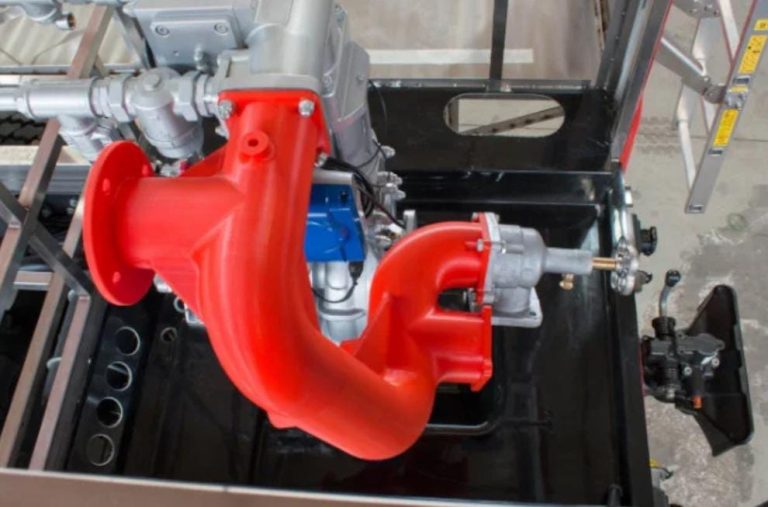
Bocar, a leading manufacturer of fire-fighting vehicles, leveraged the 3DGence INDUSTRY F340 3D printer to produce a life-size ABS prototype of a vacuum manifold. This manifold plays a key role in the hydraulic system of a fire engine’s pump compartment.
Instead of traditional metal welding (pipes, elbows, collectors), Bocar explored 3D printing as a faster, more accurate, and cost-effective prototyping method—aiming to reduce failure rates and improve overall production workflows.
The Challenge: Traditional Prototyping Is Costly and Slow
High Cost – Producing prototypes through chill-molding requires expensive tooling.
Long Lead Times – Manufacturing new chill forms can take several months.
Manual Assembly Risks – Welding pipes and components introduces alignment and durability issues.
The Solution: 3DGence INDUSTRY F340 for ABS Prototyping
By integrating industrial FDM 3D printing, Bocar was able to produce a full-scale manifold prototype in just 10 days—with a material cost of approximately 25€ per kg.
Key Benefits:
Cost Savings – Eliminates the need for chill molds in the prototype stage
Faster Development – Reduces prototype lead time from months to days
Assembly Validation – Enables direct installation and real-time testing inside a fire engine
Improved Accuracy – Ensures tighter tolerances and lower failure frequency compared to welded assemblies
Results: Design Validation with Lower Costs and Faster Turnaround
Rapid Prototyping – Allows iterative testing without committing to expensive tooling
Functional Testing – Printed part installed inside an actual vehicle for ergonomics and fit validation
Dimensional Accuracy – Physical part used to verify design assumptions and improve production planning
Bocar’s engineers confirmed that the 3D printed prototype maintained required durability and functionality, and the company now relies on 3D printing to streamline early-stage development across its product lines.
Conclusion: Smart Prototyping for Smarter Emergency Vehicles
By adopting the 3DGence INDUSTRY F340, Bocar has transformed its approach to hydraulic system prototyping—minimizing both risk and cost while accelerating innovation in life-saving equipment.
3D printing is no longer just for design—it’s a critical step in bringing functional, rugged components into real-world firefighting operations.